

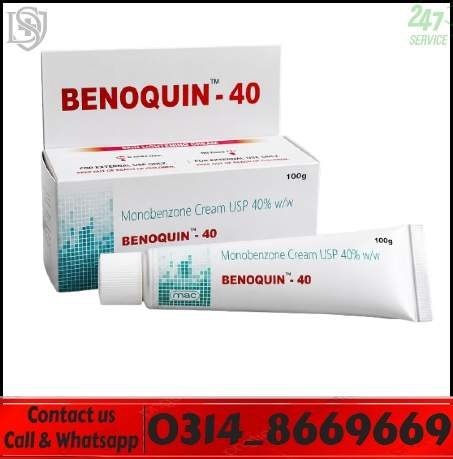
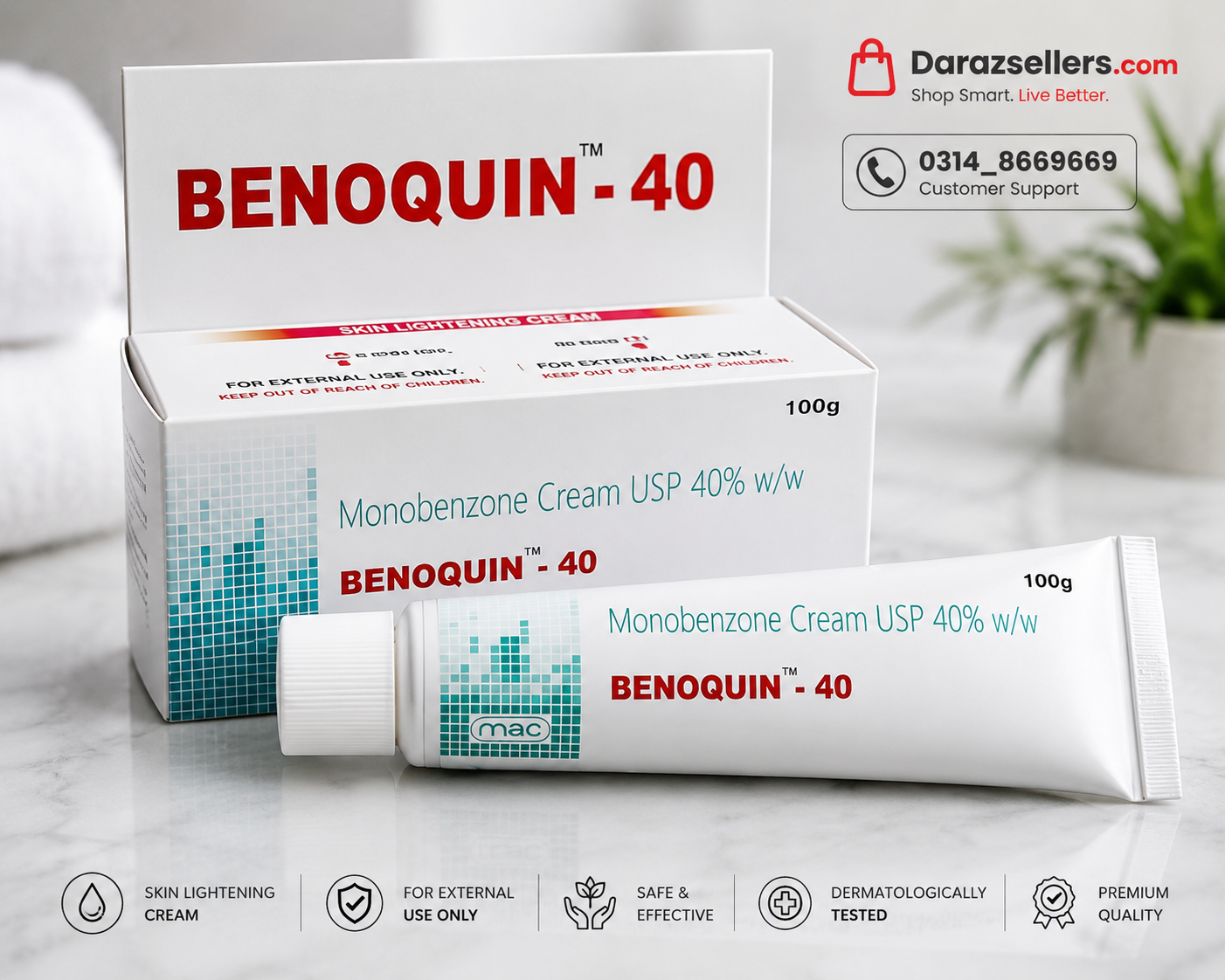
Benoquin Cream 40% (Monobenzone) – Depigmenting Cream
Benoquin Cream 40% (Monobenzone) – Depigmenting Cream, a potent depigmenting agent historically used for permanent depigmentation in extensive vitiligo. Benoquin is not an ordinary cosmetic skin-lightening cream and should only be used under specialist medical supervision.
₨6,500.00 Original price was: ₨6,500.00.₨5,500.00Current price is: ₨5,500.00.
Benoquin Cream 40% (Monobenzone) – Depigmenting Cream
Benoquin Cream is a topical depigmenting product associated with monobenzone, a potent melanocyte-depigmenting agent. It is important to distinguish Benoquin from ordinary cosmetic whitening creams and from hydroquinone-based products.
The FDA-approved Benoquin labeling describes Benoquin Cream 20% (monobenzone) as a prescription product indicated for final depigmentation in patients with extensive, disseminated vitiligo. The labeling specifically warns that monobenzone can produce irreversible depigmentation and should not be used as a cosmetic skin bleach.
Because the product requested here is marketed as Benoquin Cream 40%, customers should verify the actual strength, manufacturer, packaging, registration status, and active ingredient before use. The FDA labeling located for Benoquin concerns the 20% formulation rather than establishing approval of a 40% formulation.
What Is Benoquin Cream?
Benoquin is the brand name associated with monobenzone cream. Monobenzone is chemically different from hydroquinone even though both can affect skin pigmentation.
The historical Benoquin label describes monobenzone as a depigmenting agent whose exact mechanism is not completely understood. Topical monobenzone can affect melanocytes and may result in permanent loss of pigmentation.
This makes Benoquin fundamentally different from conventional cosmetic products intended to temporarily brighten or even skin tone.
Benoquin Cream 40% Active Ingredient
The active pharmaceutical ingredient associated with Benoquin is monobenzone.
The FDA labeling for Benoquin 20% identifies monobenzone as the active ingredient and describes each gram as containing 200 mg of monobenzone.
For a product labeled 40%, consumers should carefully inspect the packaging and manufacturer’s information because a 40% formulation is not the same strength as the historically FDA-approved 20% Benoquin formulation.
Benoquin Cream vs Hydroquinone
Benoquin and hydroquinone should not be treated as interchangeable products.
Monobenzone can produce permanent depigmentation and has historically been used for final depigmentation in extensive vitiligo.
Hydroquinone, in contrast, is used in certain topical formulations for gradual fading of hyperpigmented areas such as melasma, freckles, and other pigmentation disorders. Hydroquinone depigmentation is described as reversible.
Therefore, Benoquin should not be selected simply because a person is looking for a stronger skin-lightening cream.
Benoquin Cream Uses
The approved historical use of Benoquin 20% is highly specific: final depigmentation of normal skin surrounding vitiligo lesions in people with disseminated or extensive idiopathic vitiligo, described in the FDA label as greater than 50% of body surface area.
It is not recommended in the FDA labeling for ordinary cosmetic skin whitening or for common pigmentation problems such as:
- Freckles
- Melasma
- Pregnancy-associated chloasma
- Certain inflammatory hyperpigmentation
- Cafe-au-lait spots
- Pigmented nevi
- Malignant melanoma
- Pigmentation caused by substances other than melanin
Benoquin Cream for Vitiligo
Vitiligo can cause areas of the skin to lose pigment. In people with extensive vitiligo, some specialist treatment plans may involve depigmenting remaining normally pigmented skin so that the overall skin tone becomes more uniform.
Benoquin has historically been used for this particular purpose. The FDA has described Benoquin as an approved therapy for final depigmentation in extensive vitiligo.
This is a specialized medical use and should be managed by a dermatologist or another qualified specialist.
Does Benoquin Permanently Whiten Skin?
Benoquin should not be described simply as a permanent skin-whitening cream.
Monobenzone can cause permanent depigmentation by affecting melanocytes. The FDA label specifically warns that this effect can be irreversible.
Permanent depigmentation is a serious medical effect and is very different from temporarily reducing excess pigmentation.
Benoquin Cream 40% Safety
A product containing high-strength monobenzone should not be used casually.
Potential concerns include:
- Permanent depigmentation
- Uneven pigmentation
- Skin irritation
- Sensitivity reactions
- Unpredictable depigmentation outside the intended area
- Increased vulnerability to sun-related damage after depigmentation
The FDA labeling describes monobenzone as a potent depigmenting agent and emphasizes that Benoquin is not a cosmetic skin bleach.
Benoquin Cream Side Effects
Potential adverse effects depend on the formulation and individual response.
Possible problems may include:
- Skin irritation
- Redness
- Dryness
- Burning or discomfort
- Allergic or sensitivity reactions
- Uneven depigmentation
- Unintended permanent pigment loss
Because monobenzone can permanently affect pigmentation, unexpected changes should be discussed with a dermatologist.
Benoquin and Permanent Depigmentation
One of the most important differences between Benoquin and ordinary pigmentation creams is the possibility of permanent pigment loss.
The FDA label notes that the depigmenting effect may be erratic and can take approximately one to four months to become apparent as existing melanin is gradually lost.
This means that applying more product or using it more frequently is not an appropriate way to accelerate treatment.
Benoquin Cream 40% for Cosmetic Whitening
Benoquin should not be promoted as an ordinary cosmetic whitening product.
The FDA labeling specifically states that Benoquin is not a cosmetic skin bleach and is contraindicated for conditions other than disseminated vitiligo.
People seeking treatment for melasma, acne marks, freckles, post-inflammatory hyperpigmentation, or other common pigmentation concerns should seek appropriate dermatological advice instead of using monobenzone.
Benoquin Cream and Sun Exposure
Depigmented skin has reduced melanin protection and requires careful protection from ultraviolet exposure.
The historical Benoquin label notes that sunlight reduces the depigmenting effect during treatment, while patients with depigmented skin may require appropriate protection from sun exposure.
A dermatologist can recommend an appropriate sun-protection strategy based on the individual’s treatment.
Benoquin Cream in Pakistan
Customers searching for Benoquin Cream 40% in Pakistan should carefully distinguish between genuine branded products, compounded formulations, imported products, and online listings that may use the Benoquin name without clear manufacturer information.
Before purchasing, verify:
- Active ingredient
- Strength
- Manufacturer
- Batch number
- Expiry date
- Packaging
- Regulatory information
- Storage requirements
- Pharmacy or seller credentials
A product labeled 40% should not automatically be assumed to be the same formulation as the historically approved Benoquin 20% cream.
Benoquin Cream International Availability
International availability of Benoquin and monobenzone products can change over time. FDA materials have noted that the original Benoquin 20% product was no longer manufactured or distributed at the time of the referenced regulatory documentation.
Therefore, an online international listing does not by itself confirm current regulatory approval, authenticity, or manufacturing status.
Consumers should check the specific product rather than relying solely on the brand name.
How to Choose Benoquin Cream
For a prescription depigmenting medicine, product selection should prioritize authenticity and medical suitability over price.
Check:
- Exact strength
- Active ingredient
- Manufacturer
- Packaging integrity
- Batch information
- Expiry date
- Regulatory information
- Storage conditions
- Seller or pharmacy credentials
- Professional medical guidance
Benoquin Cream Storage
Follow the storage instructions printed on the product packaging.
Keep topical medicines:
- In their original container
- Away from excessive heat
- Away from direct sunlight
- Away from moisture
- Out of children’s reach
Do not use a product if its packaging is damaged, the cream has visibly changed, or it is past its expiry date.
Who Should Avoid Self-Using Benoquin?
Self-treatment is particularly inappropriate for people who have:
- No diagnosis of extensive vitiligo
- Unknown skin pigmentation conditions
- A history of sensitivity to monobenzone
- Unexplained skin discoloration
- Active skin irritation or inflammation
- Unclear product ingredients
The FDA labeling lists sensitivity or allergic reaction to the product or its ingredients as a contraindication.
Benoquin Cream and Pregnancy
People who are pregnant, planning pregnancy, or breastfeeding should consult a qualified healthcare professional before using a potent depigmenting medicine.
Do not begin treatment with high-strength monobenzone based solely on online product information.
Benoquin Cream for Dark Spots
Benoquin should not automatically be used for dark spots.
The historical FDA label specifically states that Benoquin is not recommended for several common hyperpigmentation conditions.
For ordinary dark spots or melasma, dermatologists may consider other approaches depending on the diagnosis.
Benoquin Cream vs Skin-Lightening Creams
Many cosmetic skin-lightening products are designed to reduce the appearance of excess pigmentation without intentionally causing complete permanent depigmentation.
Benoquin is fundamentally different because monobenzone can permanently eliminate pigment in treated skin.
For this reason, it should be regarded as a specialized medical depigmenting treatment rather than a general cosmetic product.
Frequently Asked Questions
1. What is Benoquin Cream?
Benoquin is a monobenzone-containing topical depigmenting medicine historically used for final depigmentation in extensive vitiligo.
2. What is the active ingredient in Benoquin?
The active ingredient is monobenzone.
3. What is Benoquin Cream 40%?
It refers to a product marketed as containing 40% monobenzone. Buyers should verify the actual formulation, manufacturer, and regulatory status because the FDA-approved Benoquin labeling located here concerns a 20% formulation.
4. Is Benoquin a normal skin-whitening cream?
No. The FDA labeling specifically warns that Benoquin is a potent depigmenting agent and not a cosmetic skin bleach.
5. What is Benoquin used for?
The historical FDA indication is final depigmentation in extensive or disseminated vitiligo.
6. Can Benoquin permanently remove skin pigment?
Yes. Monobenzone may cause permanent depigmentation.
7. Is Benoquin the same as hydroquinone?
No. Monobenzone and hydroquinone are different compounds with different clinical uses and depigmentation characteristics. Hydroquinone is used in certain formulations for gradual treatment of hyperpigmentation.
8. Can Benoquin be used for melasma?
The historical FDA Benoquin label does not recommend it for melasma or pregnancy-associated chloasma.
9. Can Benoquin be used for freckles?
The FDA labeling specifically states that Benoquin is not recommended for freckles.
10. Is Benoquin suitable for cosmetic whitening?
No. It should not be used as a general cosmetic skin-whitening cream.





Reviews
Clear filtersThere are no reviews yet.